


VelStop® Pollen: Comprehensive Entrance Management, Advanced Self-Cleaning, and Integrated Modular Pollen Collector
The VelStop® Pollen model represents the highest technological evolution of the system. Designed based on the advanced VelStop® IVI prototype, this device unifies selective protection against hornets and pollen harvesting into a single permanent entrance accessory. Its architecture solves purely mechanically the historical problem of organic debris and carcass accumulation suffered by other seasonal market accessories.
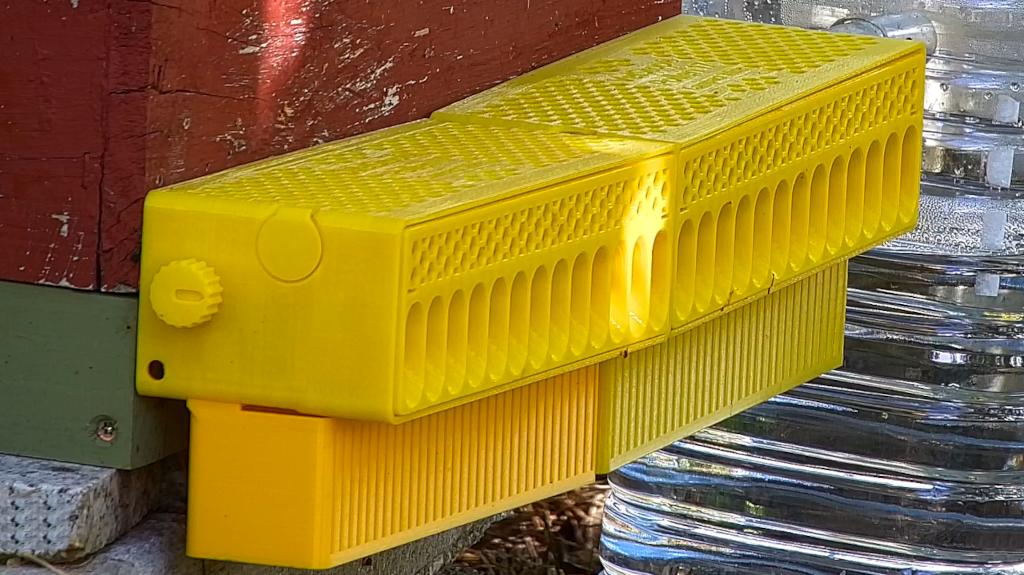
🛠 Engineering Specifications and Sanitary Design
- Field Validation Material: Manufactured via FDM 3D printing using technical PETG polymer. It has demonstrated excellent structural resistance to solar degradation (UV radiation) and impacts through years of real exposure in the apiary.
- Scalable CAD Modularity: Due to physical size limitations of the print bed (Prusa MK4S), each unit is optimized to a half-length Langstroth hive entrance (216 mm). Full coverage of a standard hive is achieved by symmetrically installing two contiguous units. Compact height of 60 mm and depth of 80 mm, a volume in which the protection device with its capture chamber and the pollen collection mechanism are compactly integrated.
- Anti-Wind Permanent Structural Anchoring: The base body is permanently fixed to the wood of the hive using screws. Unlike other entrance accessories on the market that use weak eyelets or tabs, this rigid anchoring is fully immune to wind, vibrations, or accidental wildlife disturbances.
- Biological Debris Management: It incorporates millimeter-sized 3–4 mm openings located exactly at the junction between the device and the hive entrance. These are sized precisely to completely prevent bee escape or hornet entry, while allowing workers to easily expel wax chunks, organic waste, and debris without having to drag smaller or fine material through the entire accessory. Furthermore, the filters feature basal discharge openings at their lower section. This leverages the bees' natural instinct to drag heavy debris along the ground instead of lifting it in flight, facilitating the evacuation of larger waste through the accessory. Free passage in the immediate vicinity of the hive entrance allows debris that cannot be expelled due to its size to be stored in the VelStop® protective accessory (rather than inside the hive), facilitating quick cleaning by the beekeeper using a brush.
- Simplified Entry Section: Divides the pollen collector width into optimized-length sections to fluidize worker transit by preventing jumps between sections, while allowing fast maintenance and cleaning for the beekeeper (simply pull out the front plate, lift the pollen collector filter, and sweep with a brush).
- External Tilting System for Pollen Trap Activation: The pollen collector function can be activated or deactivated via a rotary mechanism with an external manual knob.
🔄 Specific Operating Modes in the Apiary
Thanks to its modular design, the beekeeper can manage all seasonal colony needs by manipulating the components from the outside in seconds:
1. Mode 1: Direct Full Access
Only the screwed base remains fixed on the hive entrance; the front plate and filters are removed, and the pollen collector is lifted. Bees have 100% free access to the entrance section. Traffic flow, ventilation, and the colony's organic cleaning tasks are executed similarly to a traditional hive, eliminating the need to remove the equipment.
Only the screwed base remains fixed on the hive entrance; the front plate and filters are removed, and the pollen collector is lifted. Bees have 100% free access to the entrance section. Traffic flow, ventilation, and the colony's organic cleaning tasks are executed similarly to a traditional hive, eliminating the need to remove the equipment.
2. Mode 2: Medium Protection with Independent Flows
The removable front plate is inserted without filters, compartmenting the interior volume into independent passage channels. Bees transit freely toward the hive, while hornets, guided by their natural behavior and positive phototaxis (attraction to upper light), ascend in isolation into the capture chamber where they remain mechanically enclosed. This mode completely prevents hornets in the passage chamber from attacking or stressing the bees in adjoining channels, allowing the hive to continue working without interruptions through those adjacent channels.
The removable front plate is inserted without filters, compartmenting the interior volume into independent passage channels. Bees transit freely toward the hive, while hornets, guided by their natural behavior and positive phototaxis (attraction to upper light), ascend in isolation into the capture chamber where they remain mechanically enclosed. This mode completely prevents hornets in the passage chamber from attacking or stressing the bees in adjoining channels, allowing the hive to continue working without interruptions through those adjacent channels.
In this mode (with the pollen collector function deactivated), hornets can enter the hive since no filter is present, if they manage to bypass the phototaxis guidance system at the entrance. However, in their attempt to return outside, hornets will find that the adjusted passage openings leading to the capture chamber —being higher and receiving more exterior light— are far more attractive than the entry openings, leaving them trapped upon exit. During breeding season, this configuration also facilitates the natural exit of the swarm, including larger drones, ensuring optimal fertilization and safeguarding the genetic variability of the swarm while maintaining active hornet capture capability.
3. Mode 3: High Protection with Physical Exclusion
To Mode 2 operations, a filter module with calibrated circular openings is added, offering size discrimination: bees and drones transit without difficulty, but an impassable size barrier prevents hornet specimens from accessing the interior of the hive. This filter module can remain installed with the pollen trapping function activated or deactivated.
To Mode 2 operations, a filter module with calibrated circular openings is added, offering size discrimination: bees and drones transit without difficulty, but an impassable size barrier prevents hornet specimens from accessing the interior of the hive. This filter module can remain installed with the pollen trapping function activated or deactivated.
4. Mode 4: Secure Migration Closure and Total Locking
Escape blocking for transport is performed quickly and cleanly by replacing the active inner filter with a blind piece without perforations. By reinserting and locking the front plate (via the "click" snap-fit mechanism), the hive becomes hermetically sealed for migration without the need to introduce temporary foams. It is also possible to use a closure accessory from the VelStop® IVI prototype as a lock or barrier instead of the front plate. Although the "click" system firmly locks the closure, intense vibrations or severe bumps on rural roads might dislodge the front plate and lock, which may require an additional external fixture.
Escape blocking for transport is performed quickly and cleanly by replacing the active inner filter with a blind piece without perforations. By reinserting and locking the front plate (via the "click" snap-fit mechanism), the hive becomes hermetically sealed for migration without the need to introduce temporary foams. It is also possible to use a closure accessory from the VelStop® IVI prototype as a lock or barrier instead of the front plate. Although the "click" system firmly locks the closure, intense vibrations or severe bumps on rural roads might dislodge the front plate and lock, which may require an additional external fixture.
5. Mode 5: Active Pollen Collector Mode
Via an external manual rotary knob provided with a rotation axis, the pollen collector filter is quickly activated/deactivated from the outside, guaranteeing that the pollen drops cleanly without requiring the disassembly of any protective element. Upon passing through, the bees detach the pollen pellets from their hind legs, which fall through the basal grid into the ventilated collection drawer. The accessory features dividers that limit traffic per section, enabling a higher entrance flow rate. The pollen collector mode can function with or without an entry filter (Modes 2 and 3).
Via an external manual rotary knob provided with a rotation axis, the pollen collector filter is quickly activated/deactivated from the outside, guaranteeing that the pollen drops cleanly without requiring the disassembly of any protective element. Upon passing through, the bees detach the pollen pellets from their hind legs, which fall through the basal grid into the ventilated collection drawer. The accessory features dividers that limit traffic per section, enabling a higher entrance flow rate. The pollen collector mode can function with or without an entry filter (Modes 2 and 3).
🚀 Industrial Advantage and Scalability for Injection Molding
The geometric design of the VelStop® Pollen prototype can be adapted for high-volume plastic injection molding (utilizing high-density industrial polymers such as PP or HDPE with UV protection additives). Industrialization under a licensing agreement will allow the creation of a single accessory with a full hive-entrance length. This will optimize postal packaging for the retail market, reduce installation times for the beekeeper (a single device per hive), and drastically lower manufacturing costs. This will definitively resolve the cost limitations of 3D printing, offering the international market a premium, robust, and highly competitive product under a clean royalty-bearing model per unit sold.
📺 Practical Demonstration of Configurations
In the following video, you can observe how the manual transition of the VelStop® Pollen between different operating modes is performed in the apiary:
The following video shows the pollen collector in operation: