


VELSTOP®: Patent-Pending Innovation in Comprehensive Beekeeping Protection
Technical All-in-One Hive Entrance Accessory: Protection against invasive species, secure migration, and integrated pollen collector.
📢 COMMERCIAL AND INDUSTRIAL LICENSING OPPORTUNITY
Technology in International Expansion Phase
VelStop® is an all-in-one engineering system for beehive protection, exhaustively field-tested in real apiaries.
Currently, the industrial property includes:
- Published International Patent Application: PCT/ES2025/070001 (WO2025146518A1).
- European Regional Phase (Euro-PCT): Actively being processed.
- Granted Industrial Design: D0536452-01 (Spain).
- Registered Trademark: VelStop® (M4249293).
Seeking Industrial Partners: The current CAD design is optimized and validated for 3D printing (FDM in PETG), ready to be adapted for the definitive high-volume plastic injection molding.
We offer Exclusive Manufacturing, Industrial Injection, and International Distribution Licensing Agreements under a royalty-bearing model.
The intellectual property owner does not contemplate direct manufacturing, retail distribution, or independent marketing. We are looking for an industry leader or manufacturer to take over industrial production, the distribution network, and commercial management. The inventor will provide exclusive technical support for design optimization (adaptation to injection molds) and assistance in processing the patent phases.
📢 BEEKEEPING COLLABORATION: DISCOVER THE VELTRAP
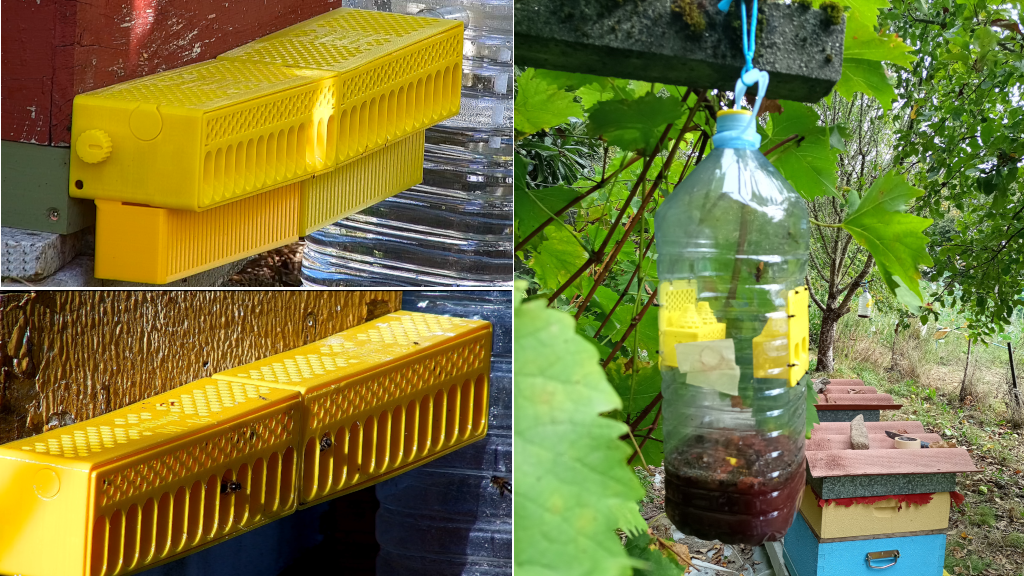
While we actively manage the technology transfer of our permanent hive entrance patents (VelStop® IVI / Pollen) to the industry for plastic injection molding production, we want to provide immediate solutions for the apiary.
We have released the 3D printing files for the VelTrap completely free of charge. This is a standalone component engineered to increase hornet captures by reusing common rigid plastic jugs.
How can you help us bring this system to retail stores through mass production?
3D printing is great for testing prototypes, but it is slow and costly for mass supply. To achieve an affordable retail price for VelStop® entrances, we need to show genuine market demand to the industry through 3 simple steps:
- Step 1: Support us on YouTube. Watch our assembly video tutorial. Click "Like", subscribe, and leave a short comment. This helps YouTube recommend the video to more manufacturers.
- Step 2: Download and test the designs. Visit Printables or Thingiverse, download the files, print them, and upload a picture of your setup ("Make") if it works well for you.
- Step 3: Ask at your local shop. Contact your regular beekeeping equipment dealers and inquire about VelStop® to encourage high-volume industrial production.
🐝 Pillars of Technological and Operational Innovation
Unlike temporary or artisanal traps on the market, the VelStop® system is a permanent technical accessory for the hive entrance that optimizes apiary management throughout the year based on five fundamental axes:
1. "Install and Forget" Permanent System (High-Resistance Anchoring)
- Goodbye to seasonal accessories: Most traps use weak fixtures (eyelets or tabs) designed to be attached and removed depending on the season, compromising their resistance to wind and impacts.
- Fixed structural anchoring: The VelStop® base is permanently installed on the hive entrance using screws. It is mounted only once and is not removed all year round. When there is no predator pressure, the removable front and the filters are taken out: the base alone does not restrict traffic at all, matching the behavior of a conventional hive entrance.
- Unification of equipment at the entrance: Resolves the classic space conflict in the apiary. There is no need to choose between protecting the hive or harvesting pollen; the Pollen version integrates both functions onto the same permanent screwed support.
2. Independent Flow Management and Selective Capture
- No attacks in transit zones: The interior volume is compartmented into independent passage lanes. If a predator enters, positive phototaxis redirects it upward into the capture cavity. Since the lanes are mechanically isolated, it completely prevents the predator from blocking, stressing, or killing the bees that continue to operate freely through the adjacent cavities. The hive continues to operate normally through the rest of the independent channels.
- Biological protection and multi-species control: Optimized against the Asian hornet (Vespa velutina), its design and modular filters make it potentially effective for capturing and monitoring other global threats such as the Oriental hornet (Vespa orientalis) or other large vespids.
- Genetic safety during swarming: By allowing the removal of the front plate and the filter, or configuring different modular filters during critical periods, it avoids the serious issue of fixed traps that retain large drones during breeding season, thus safeguarding the genetic variability of the swarm.
3. Operational Versatility and Dynamic Operating Modes
The modular design allows the beekeeper to switch in seconds between 4 key operational modes depending on the season:
The modular design allows the beekeeper to switch in seconds between 4 key operational modes depending on the season:
- Mode 1 (Full Access): Only the base is present. Traffic, ventilation, and cleaning are 100% free.
- Mode 2 (Medium Protection): Front plate inserted. Activation of independent passage channels and redirection of predators to the capture chamber.
- Mode 3 (High Protection - Physical Exclusion): Quick-install filter modules are added depending on hornet pressure, colony weakness, or for overwintering, acting as an impassable barrier based on size.
- Mode 4 (Migration Closure): Designed for secure transport of hives without the need to introduce temporary foams. On the Pollen model, locking is immediate by replacing the active filter with a blind piece through a "click" snap-fit system. On the IVI model, the closure accessory, in addition to being locked by the click system, can be firmly screwed and features circular protrusions that fit into the filter holes, preventing bumps on rural roads from dislodging the lock.
4. Integrated High-Efficiency Pollen Collector (Pollen Model)
- External rotational activation: Allows activating or deactivating the pollen trapping function from the outside via a manual rotary knob, without the need to disassemble, unfasten, or remove the base accessory from the hive entrance.
- Stress-reducing separators: Features a technical design that limits the number of accessible pollen-trapping openings per section. This balances an efficient harvest of clean pollen with fluid transit, avoiding bottlenecks and traffic stress caused by traditional pollen traps, while facilitating cleaning.
5. Advanced Hygiene and Field Self-Cleaning
- Technical evacuation slots: Features millimeter-sized 3-4 mm openings optimized between the device and the hive entrance, which completely prevent bee passage but allow workers to easily expel organic debris, improving the self-cleaning of the hive.
- Basal discharge filters: The filter openings are strategically located at ground level. This leverages the bees' natural instinct to drag debris, facilitating the expulsion of heavy waste along the bottom of the device without forcing them to lift it in flight. Debris that is too large remains isolated and can be safely mummified with propolis outside the hive, while being easily removed by the beekeeper using a brush.
- Unified cleaning in seconds: Post-filter access has been simplified with fewer sections, making maintenance and cleaning fast for the beekeeper (it is as quick as pulling out the front plate and filter and brushing them off).
🚀 Industrial Viability: From 3D Printing to Injection Molding
Our current prototypes are optimized for additive manufacturing (FDM in PETG) and have demonstrated excellent structural resistance under real field conditions, enduring continuous weather exposure and external impacts for years in the apiary without loosening from their mountings.
Due to the physical size limitations of conventional 3D printing, the current prototypes are produced in a half-hive-entrance length format. For mass commercial viability, the project requires an industrial licensee to undertake the redesign for high-volume plastic injection molding (such as PP or HDPE with UV protection), which will allow:
- Drastically reduce manufacturing costs for the retail market (avoiding double assembly costs).
- Unify the accessory into a single piece of full hive-entrance length, offering beekeepers a product that is more convenient, faster to install, and commercially competitive.
🔬 Scientific and Beekeeping Sector Collaborations
We invite Beekeepers' Associations, Professional Collectives, and University Research Groups to collaborate with us:
- We seek to establish synergies to evaluate the mechanical efficacy of the device against different vespid species (Vespa velutina, Vespa orientalis, etc.) across diverse geographical regions.
- We are interested in technical validation through field reports and the exchange of scientific data.
- We assess the feasibility of providing technical test units in a coordinated manner for institutional research projects and invasive species monitoring.
📺 Field Efficiency Demonstration